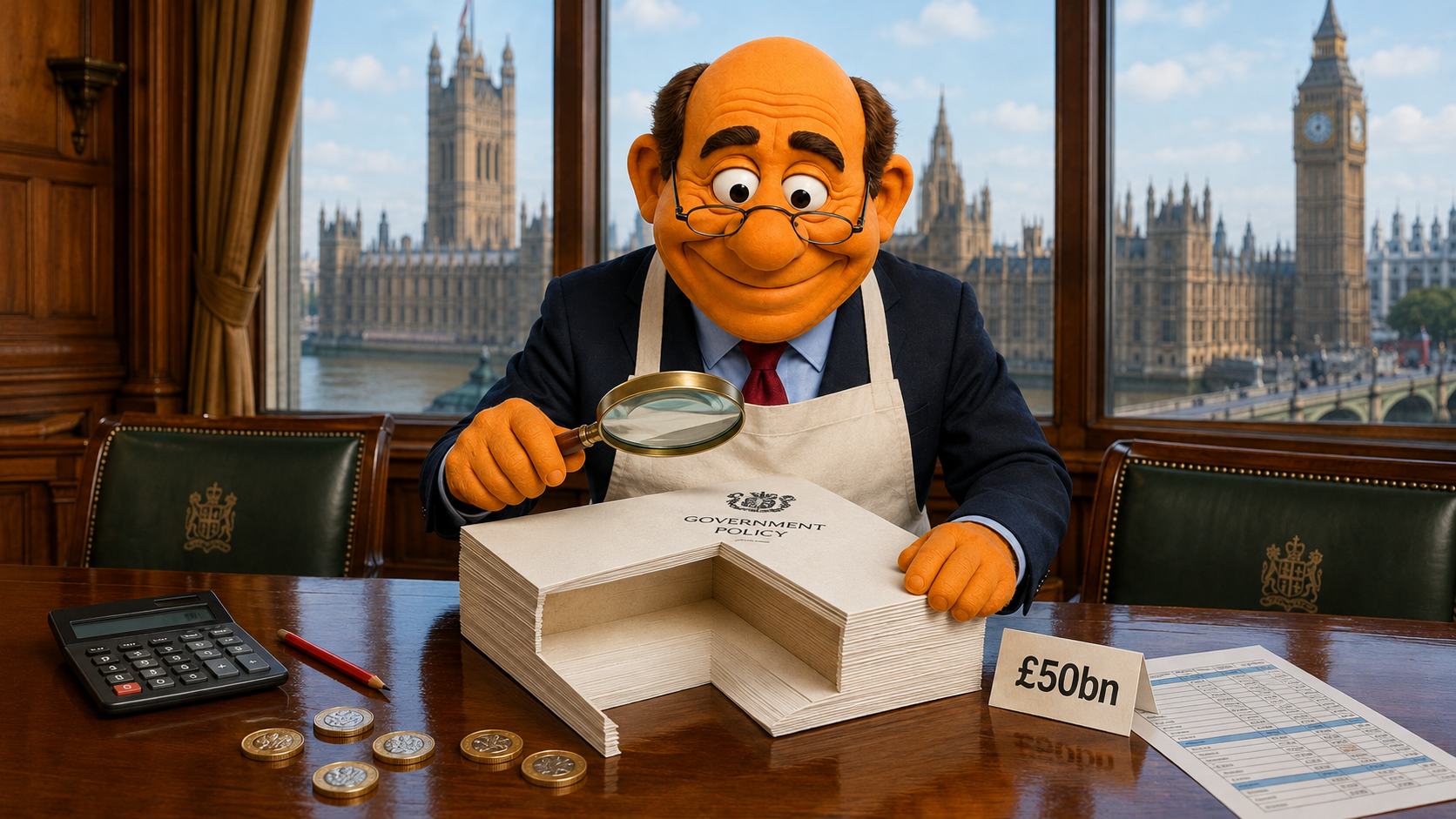
Reform UK has announced plans to remove £50 billion a year from Britain’s welfare bill, proving once again that the easiest way to save an enormous sum of money is to announce it on a Sunday before anybody can inspect the spreadsheet.
The full policy document is expected on Monday. This means the headline has arrived before the workings, which is increasingly how modern government saves on postage.
POLICY ON THE TABLE
Reform proposes abolishing Personal Independence Payment and the health-related element of Universal Credit for working-age adults.
A new, regularly reviewed “health security allowance” would provide cash support to people Reform describes as “gravely ill and severely challenged.”
People with what the party calls “lower-level conditions” would instead receive disability support accounts administered by councils and mayors. These accounts could cover approved equipment, adaptations, transport and personal assistance.
Employers would also be expected to fund insurance covering the first two years of an employee’s long-term sickness absence.
Reform says the overall package could remove £50 billion from annual welfare spending.
This is less a trim than entering the Department for Work and Pensions with a chainsaw and asking which wall is load-bearing.
THE PIP PROBLEM
The first difficulty is that PIP is not an unemployment benefit.
It helps meet the additional costs created by disability and long-term health conditions. It is not means-tested, and people can receive it while working or holding savings.
Removing PIP as part of a plan to encourage employment therefore risks taking support away from some of the people already managing to remain in work.
It is the policy equivalent of confiscating somebody’s walking stick to improve their time in the hundred metres.
None of this means the existing system works perfectly. Spending is increasing, assessments are frequently criticised and too many people experience a process that feels designed to establish whether persistence can be medically diagnosed.
Reform is entitled to ask whether the system is sustainable.
It is not entitled to treat asking the question as the same thing as supplying the answer.
THE £50 BILLION QUESTION
The largest organ on the examination table is the claimed £50 billion saving.
That figure is vast. The Office for Budget Responsibility forecast spending on incapacity and disability benefits rising from £75.7 billion in 2024–25 to £97.7 billion by 2029–30.
Reform is therefore proposing to remove a sum equivalent to more than half of that projected annual spending.
Such a claim requires more than a press release. It needs independently tested assumptions covering eligibility, administration, appeals, local-authority costs, employer behaviour and the consequences for health services, housing and social care.
If support disappears from one departmental spreadsheet but the resulting cost reappears at a council, hospital or employer, the country has not saved money. It has moved the invoice.
ACCOUNTS INSTEAD OF CASH
Replacing cash payments with council-administered accounts also raises practical questions.
Who decides which expenses are permitted? Can somebody use an account for fuel, heating or food when their condition increases those costs? Will every council apply the same rules? How frequently must claimants provide evidence?
Britain already contains enough postcode lotteries without installing a ticket machine.
Cash gives disabled people some control over how they meet the additional costs of their condition. A restricted account transfers that judgment to an administrator who may never have met them.
That may reduce expenditure. It may also reduce independence.
Those are not necessarily the same achievement.
THE VERDICT
Reform has identified a genuine political problem: welfare spending is rising, public confidence is weak and the existing assessment system satisfies almost nobody.
Its proposed answer, however, currently contains a headline saving, several sweeping abolitions and a replacement system described largely through adjectives.
Until the complete policy and costings are available, £50 billion remains a claim rather than a result.
The patient may indeed require treatment.
At present, Reform has supplied a diagnosis, a chainsaw and an invoice for money it says will no longer be spent.
The medical notes are expected on Monday.