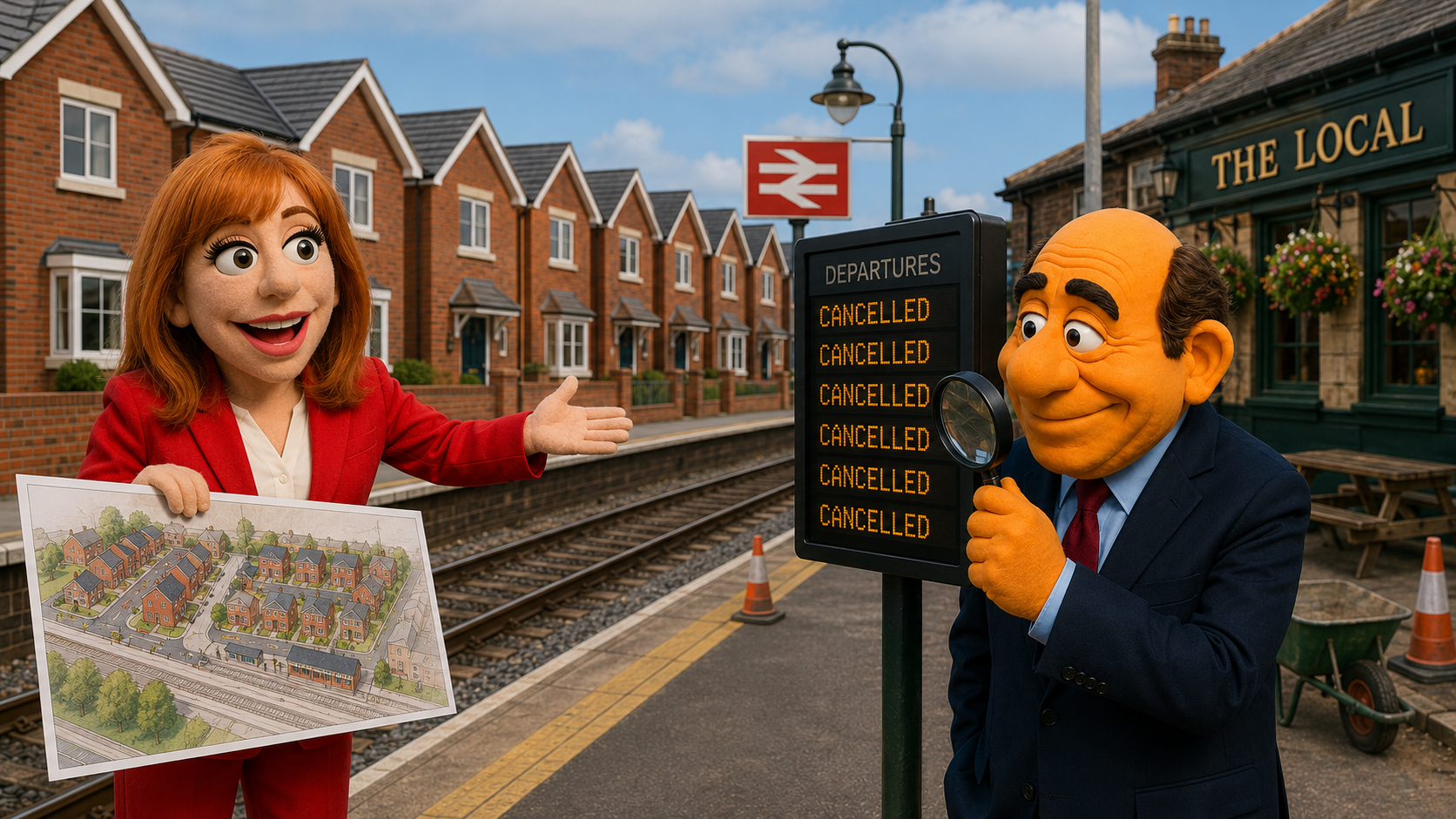
Labour has announced that new homes built near railway, tram and Underground stations will receive a “default yes” from the planning system.
This is intended to accelerate housebuilding, reduce car dependency and place thousands of new residents within convenient walking distance of a cancellation announcement.
At the same time, England’s pubs will receive stronger protection from developers. Before turning one into flats, offices or another shop selling disposable vapes, developers will have to demonstrate that the pub has no reasonable prospect of survival.
In most cases, it must first have been offered for sale for at least twelve months.
The government has therefore produced a joined-up national plan: build people beside stations, preserve somewhere for them to wait, and hope nobody asks when the train is coming.
THE HOUSING PLATFORM
Labour still intends to deliver 1.5 million homes during this Parliament. However, approximately 392,400 additional dwellings have reportedly appeared during its first 23 months.
The target has not been abandoned. It is simply standing further down the platform than originally advertised.
Housing close to public transport is, in principle, sensible. It can reduce car use, support local businesses and make employment more accessible.
It can also create a remarkable new category of commuter accommodation: a £380,000 flat overlooking a railway line whose service was withdrawn three weeks after completion.
“Default yes” should speed up applications, but planning permission does not lay bricks. Developers still require land, labour, materials, finance and an appetite for constructing homes rather than waiting for the land to become more valuable.
The planning system may open the gate. It cannot force anybody through it.
SAVING THE LOCAL
The protection for pubs is easier to welcome.
Almost 800 pubs have reportedly closed this year, with dozens demolished or converted. Under the revised rules, councils must consider their importance to the surrounding community before approving a change of use.
This recognises that a pub is not merely a commercial building. It is also a meeting place, unofficial advice centre, emergency dining room and occasional venue for explaining national economic policy with beer mats.
However, preventing a pub from becoming flats does not necessarily prevent it from becoming an empty pub.
Planning protection cannot repair high operating costs, falling custom or the price of a pint that now arrives with the emotional weight of a mortgage application.
THE VERDICT
Labour’s proposal contains two broadly sensible ideas: build homes where transport already exists and stop viable pubs being casually erased from communities.
The difficulty is that Britain possesses an exceptional ability to approve housing without building it and protect businesses without making them affordable to operate.
The policy has reached the correct station.
Whether the houses, trains or surviving pubs arrive with it remains subject to delays.